 English
 русский
The Paw Is a Cut Pattern, Not a Printed Graphic
Start with the conclusion: on a bear paw slipper, the toe pads are the most expensive detail on the upper, and they are almost never printed. Each pad is cut from a separate piece of plush, filled with a small amount of polyester wadding, and stitched onto the vamp. A five-pad paw typically adds four to seven sewing operations per pair compared with a plain plush upper, which is why two quotations for a similar-looking slipper can differ by fifteen percent.
The numbers worth writing into a spec sheet are simple. Pad diameters usually fall between 20 mm and 38 mm, wadding runs from 6 g to 15 g per pad, and seam allowance sits at 3 mm to 5 mm. When operators position pads by eye, the left and right slipper drift apart and the pair looks homemade in a photograph. A cutting template with a marked centre line fixes that for the cost of one extra pattern.
Pile direction is the second invisible cost. Plush has a nap, and if the pads are cut in a different direction from the vamp, the two areas read as different shades the moment a customer stands near a window. Mark every pattern piece with a grain arrow and keep the direction identical on both feet.
Patterns built around paws, such as our tiger paw slippers for kids, show how far the idea can be pushed before the upper stops being workable: the pads carry the whole design, the vamp stays plain, and the pattern stays easy to grade across sizes.
Grading deserves one more line. For children's sizes the pads can shrink with the shoe. For adult sizes, keep pad size constant and let the spacing grow instead. Scaling a paw up by the same ratio as a size 41 shoe produces a cartoon hand rather than a paw.
Why Pink Plush Is Harder to Hold Than Grey or Brown
Pink moves. That is the whole problem, and it is why a shade tolerance written as "light pink" will not survive a production run. Polyester plush is dyed with disperse dyes, and the final shade depends on pile height, pile density and the base fabric underneath. The same colour reference on a 220 g/m² pile and a 280 g/m² pile will read as two different pinks on the same shelf.
The practical answer is a number. Agree a colour reference, agree a Delta E tolerance, and check it in a light box rather than under a desk lamp. A tolerance of 1.0 or tighter keeps a pink range visually coherent across a season. Anything above 2.0 starts to look like a different product when the cartons sit side by side.
| Pink family | Typical build | Common failure | Check to run |
|---|---|---|---|
| Blush or baby pink | PV plush at 220 to 250 g/m² with a cream sole | Reads washed out or greyish against a pale sole | Lab dip plus Delta E of 1.0 or less, upper and sole approved together |
| Candy or hot pink | Pile at 260 to 300 g/m² with darker piping | Wet crocking and colour transfer onto socks | Wet rubbing grade of 3 to 4, plus a wear test with white socks |
| Dusty rose | Printed pads on brushed plush | Printed pads drift lighter than the surrounding pile | Pad and pile compared under D65 before approval |
| Deep winter pink | Coral fleece with polyester fill | Pile flattens and dulls after washing | Home wash test with pile height retention of 80 percent or better |
One more habit saves trouble: separate dye lots. Plush is dyed in batches, and a second batch of the same shade can be visibly different. Ordering the full quantity from one lot costs a little flexibility and removes an entire category of complaint.
Soles, Linings and the Parts Buyers Never See
The outsole and lining decide whether a pink plush slipper survives its first month. They are also the easiest places to remove cost without changing the appearance of the sample, which is exactly why they need to be specified rather than described.
For a soft, quiet indoor slipper, a 3 mm to 4 mm TPR outsole with moulded anti-slip dots usually wins. A Shore hardness of 55 to 65 A gives grip without turning stiff in a cold room. EVA is lighter and cheaper but leaves marks on pale floors, and a fabric or felt base is comfortable and wears out quickly. If the slipper is aimed at stairs, tiled hallways or an older wearer, ask for the outsole sample and test it wet.
Inside, brushed velour and short plush are the standard choices. Both feel warm, but neither moves moisture well on its own, so a slipper worn for hours can leave feet clammy. A moisture-wicking inner lining, or an insole with a perforated layer, costs little and separates a product that gets reordered from one that gets returned. The notes on how paw-style plush slippers are built cover this ground in more detail.
Sole thickness is a commercial lever as much as a comfort one. A 16 mm platform feels lighter and trims material, while a 20 mm platform feels warmer and reads more premium in photographs. Decide which one the price point supports before sampling, not after.
Warmth, Washing and Shape Retention in Winter Pink
For cold-weather pink, the colour is the least of the technical problems. Warmth comes from trapped air, so pile density and filling weight do the work. A winter fuzzy slipper with 12 mm to 16 mm pile and 80 g to 120 g of filling per pair holds heat well without turning into a boot.
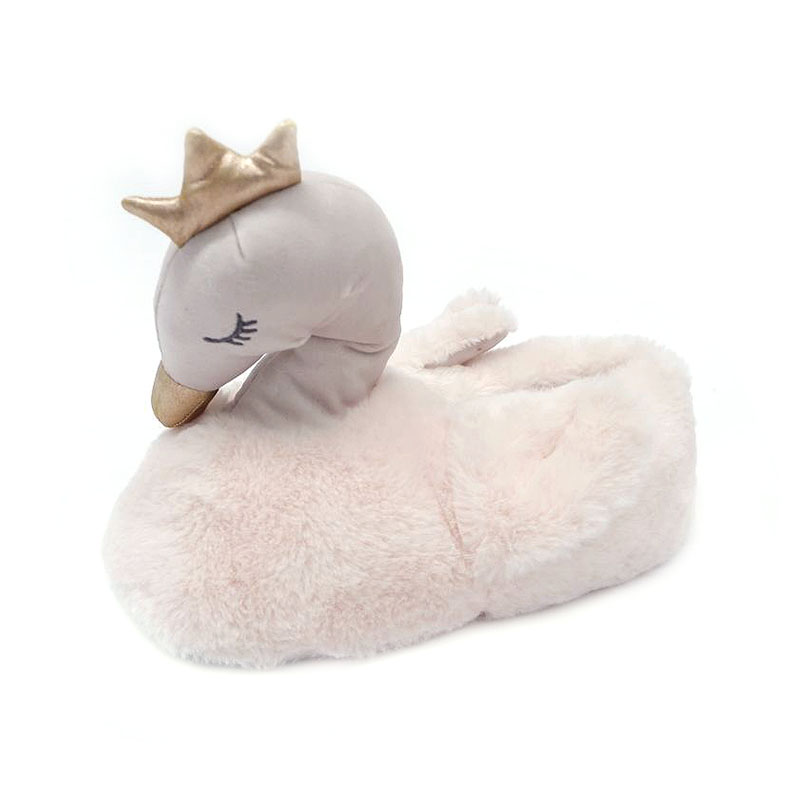
Our pink swan princess slippers sit in that range: a plush upper, a filled insole and a soft back edge that covers the heel without pressing on the ankle. The construction is deliberately ordinary, because the customer is buying the shape and the shade rather than a technical feature.
Washing is where pink projects usually fail. Pile mats when it is agitated hard or dried with heat, and a matted slipper loses both its softness and its shade. A care label that reads lukewarm hand wash, no bleach, no tumble dry and dry flat away from direct sun prevents most of the damage.
Also check that the shape comes back. A slipper that keeps its outline after washing still looks cared for; one that curls at the toe looks old by the second season.
Where Pink Paw Slippers Sell, and to Whom
Pink plush sells in four predictable pockets: women's winter ranges, gift and holiday sets, tween and teen novelty, and children's character-led designs. The buyer profile changes the specification far more than the colour does.
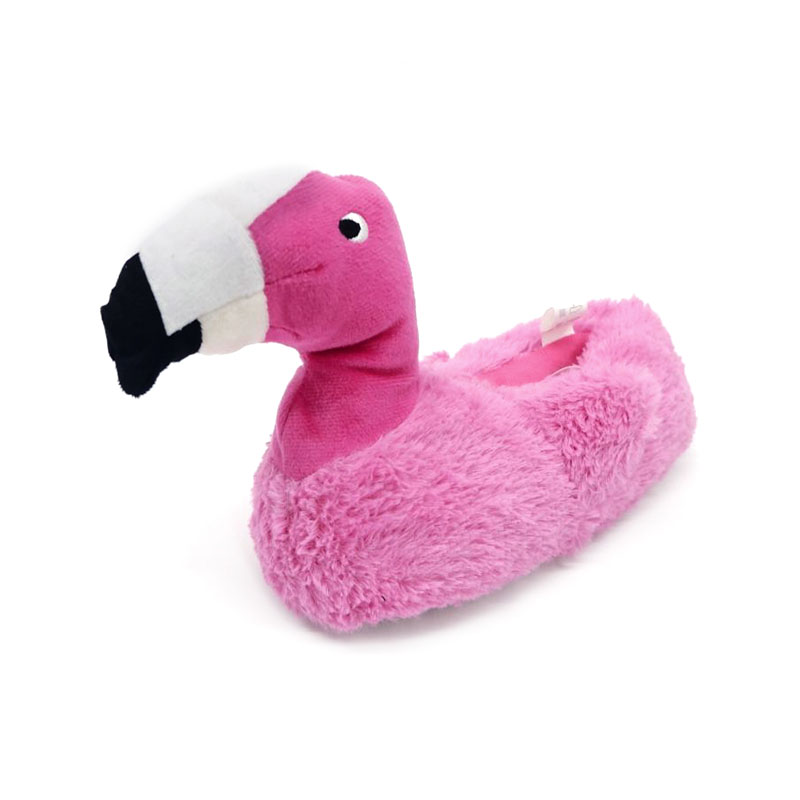
For women's lines, decorative pinks with a clear character, such as a flamingo or a swan, carry a higher price than a plain pink mule, because the customer is buying a small piece of personality rather than basic warmth. For girls' ranges, the same design language has to survive a different set of rules.
Children's versions need attention at the face. Eyes, noses and small appliqués must pass pull and torque testing, and dyestuffs and plasticisers need to meet the children's standards in the destination market. Children's slippers also get washed more often and worn harder, so reinforcement at the heel and toe is not optional.
Men's paw styles exist, but pink stays overwhelmingly on the women's and kids' side of a catalogue; grey, brown, navy and black carry the men's volumes.
Sizing and Fit, the Complaint You Can Prevent
Most returns on plush slippers are fit complaints, and most of those start with a pattern error of two or three millimetres. A pattern that is comfortable in a size 38 can pinch in a size 41 when the grading is done by eye.
Three rules keep it clean:
- Grade the opening and the toe box separately from the length, so the foot slides in easily without the slipper feeling loose once it is on.
- Allow 8 mm to 10 mm of toe room in front of the longest toe, and write a length tolerance of plus or minus 5 mm into the specification.
- Treat heelless and back-covered styles as two different patterns; a heelless slipper that fits a wide foot should not be graded from a narrow last.
None of these rules adds cost. They only add paperwork, and paperwork is cheaper than a container of slippers that nobody can sell.
What Belongs in the Spec Sheet Before You Ask for a Price
A pink bear paw slipper has about nine variables that decide its cost, and leaving any of them out of the enquiry usually produces a low quote followed by an argument. Put these in writing first:
- Upper fabric, pile height and pile weight in grams per square metre.
- Filling type and grams per pair, plus filling per individual pad.
- Colour reference and Delta E tolerance, with the light source named.
- Outsole material, thickness, hardness and anti-slip pattern.
- Size range with a grading table and a length tolerance.
- Lining material and the expected breathability level.
- Packaging: polybag, hangtag, gift box or display carton.
- Testing requirements for the destination market, plus social audit paperwork.
- Number of sample rounds and who signs off the final pair.
We are a slipper manufacturer in Cixi, Ningbo, working from roughly 9,000 square metres with six production lines and an annual output of about four million pairs. Both OEM and ODM orders are part of the routine, BSCI certification is in place, and more than twenty technicians keep patterns and materials moving. Being close to Ningbo port keeps export logistics straightforward. You can see our indoor and animal slipper range for examples of how these specifications come together.
Cost, MOQ and Lead Time: The Practical Floor
Three things drive the price of a pink plush slipper more than anything else: pile weight, the number of cut and sewn details on the upper, and the outsole material. Moving a pad from printed to stitched, or pile from 220 to 280 g/m², changes cost more than any negotiation over labour rates.
Typical minimums land between 500 and 1,000 pairs per colourway, with sampling around one week and bulk production around 30 to 45 days after approval, longer over Chinese New Year. Those figures are quotes rather than rules, and they move with fabric availability, so confirm them before you build a launch date on top of them.
Pink bear paw slippers are a simple product with a long list of small decisions behind them. The paw pads are a cut pattern, so they cost labour and need a template. The pink is a dye result, so it needs a tolerance and a light box. The warmth is trapped air, so it needs pile weight and fill. The fit is measured in millimetres, so it needs a grading table.
Buyers who settle those four things before sampling get fewer arguments, fewer returns and a slipper that still looks like the sample in the second season. Approve the pattern, the pile, the shade and the grade in writing, and a pretty pink sample has somewhere sensible to go.